
In official fiscal year 2025 figures, retaliation is the most common allegation in Ohio Civil Rights Commission cases and appears in two-thirds of Ohio EEOC charges.
A data brief from Jeckering & Associates, LLC, Columbus, Ohio
November 10, 2026. Figures checked against the official source files the same day.
Retaliation is no longer a side claim in Ohio discrimination charges. In the latest official counts from both the Ohio Civil Rights Commission and the U.S. Equal Employment Opportunity Commission, it is the allegation that shows up most often.
The Ohio commission received 7,982 cases in state fiscal year 2025, which ran from July 1, 2024, through June 30, 2025. Retaliation was the leading alleged basis, recorded 5,226 times. That was 25.52 percent of all 20,479 alleged-basis instances in the commission’s table — and, if each case was counted only once in that row, 65.5 percent of the 7,982 cases.
In the EEOC’s federal fiscal year 2025, which ended September 30, 2025, 1,929 of Ohio’s 2,892 charges — 66.7 percent — included a retaliation basis. Nationwide, retaliation appeared in 54,350 of 88,201 charges, or 61.6 percent. That 66.7 percent is Ohio’s own highest retaliation share in any year of the EEOC’s state tables, which go back to fiscal year 2009, and 5.1 percentage points above the national figure.
Those two official series are not the same pile of cases and should not be added together. Read side by side, they tell a consistent Ohio story: in both systems, roughly two-thirds of the most recent charges allege retaliation.
Key findings
- The Ohio Civil Rights Commission received 7,982 cases in FY2025, up 203, or 2.6 percent, from 7,779 the year before.
- Retaliation was the largest alleged basis, at 5,226 instances. If that row counts each case once, 65.5 percent of commission cases alleged retaliation.
- Disability (2,760), race (2,446), and sex (1,644) were the next-largest published bases.
- Employment remained the dominant charge type, at 6,033 cases, or 75.58 percent.
- Discharge or termination was the most commonly alleged harm, at 2,921 instances, followed by harassment or sexual harassment, at 1,694.
- Two-thirds of Ohio EEOC charges in FY2025 included retaliation, compared with 61.6 percent nationwide. That is Ohio’s own highest share in any year of EEOC data back to FY2009.
Ohio commission cases are still rising
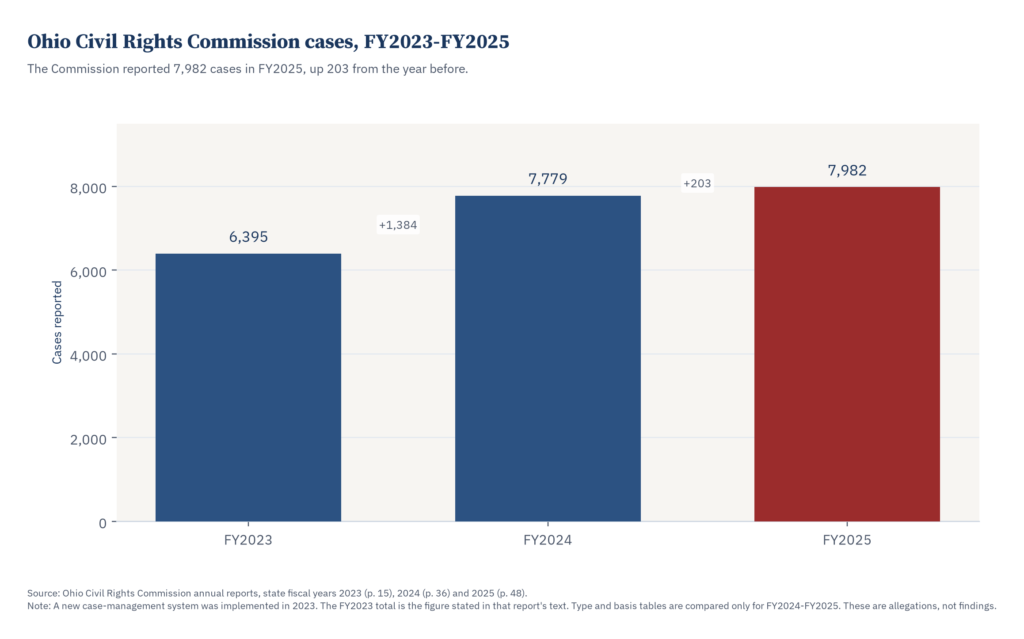
The commission reported 6,395 cases in FY2023, 7,779 in FY2024, and 7,982 in FY2025. Its FY2025 report says alleged charges have been “steadily on the rise” over the past three fiscal years. A new case-management system was implemented in 2023, so this brief uses the FY2023 total as stated in that year’s text and starts comparable type and basis analysis with the cleaner FY2024 and FY2025 tables.
Employment is still the core of the caseload: 6,014 of 7,779 charges in FY2024 and 6,033 of 7,982 in FY2025, or 75.58 percent of the later year. Housing fell from 1,147 to 1,025. Public accommodation charges rose from 539 to 715, and credit charges rose from 37 to 157, the largest percentage increase, as the commission itself reported.
The FY2025 report does not include a region-by-region table. In FY2024, the Columbus region accounted for 1,937 of the 7,779 charges, followed by Cleveland (1,765), Dayton (1,544), Toledo (1,323), and Akron (1,210).
Retaliation leads the alleged bases
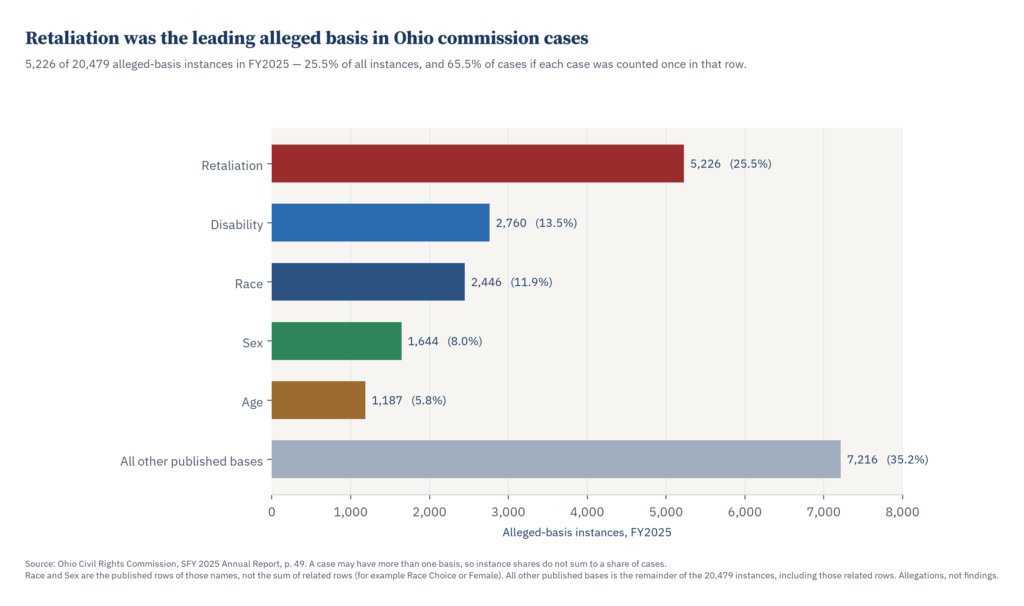
One case may carry several bases, which is why 7,982 cases produced 20,479 alleged-basis instances. Retaliation, listed as a single category, was the largest, at 5,226, or 25.52 percent of the table. The FY2025 report says retaliation “remained the largest category,” and the FY2024 report’s bar chart shows the same ranking, though that chart does not print exact counts.
The 65.5 percent case-share figure is 5,226 divided by 7,982. It is valid only if the published Retaliation row counts each case at most once — the natural reading of a single-category row, but a derived figure, not a percentage printed by the commission. It should not be confused with 25.52 percent, which is retaliation’s share of all basis instances.
Disability, race, and sex follow, using the published rows of those names. This brief does not add the commission’s separate “Race Choice” or “Female” and “Male” rows to those totals, because those rows already sit in the 20,479-instance figure and may overlap in meaning.
Discharge is the most commonly alleged harm
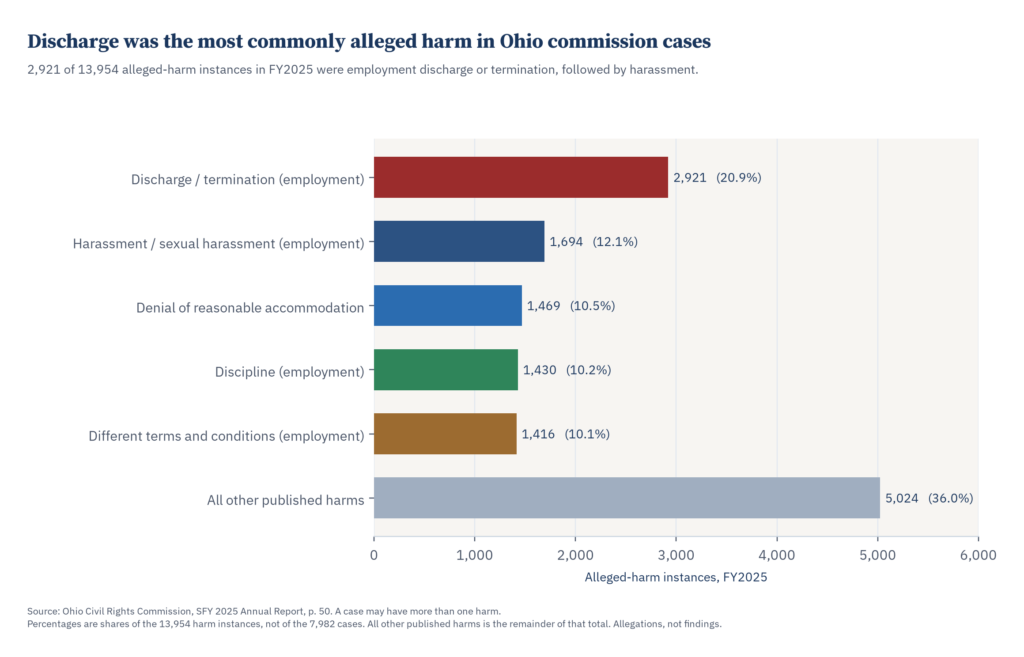
The same 7,982 cases carried 13,954 alleged-harm instances. Employment discharge or termination was the largest category, at 2,921 instances, or 20.93 percent of that table. Harassment or sexual harassment was next, at 1,694 (12.14 percent), then denial of reasonable accommodation (1,469), employment discipline (1,430), and different terms and conditions of employment (1,416). The commission said employment discipline had the biggest increase among alleged harms; the published table does not include a prior-year count for that row.
Ohio’s EEOC retaliation share is at a series high
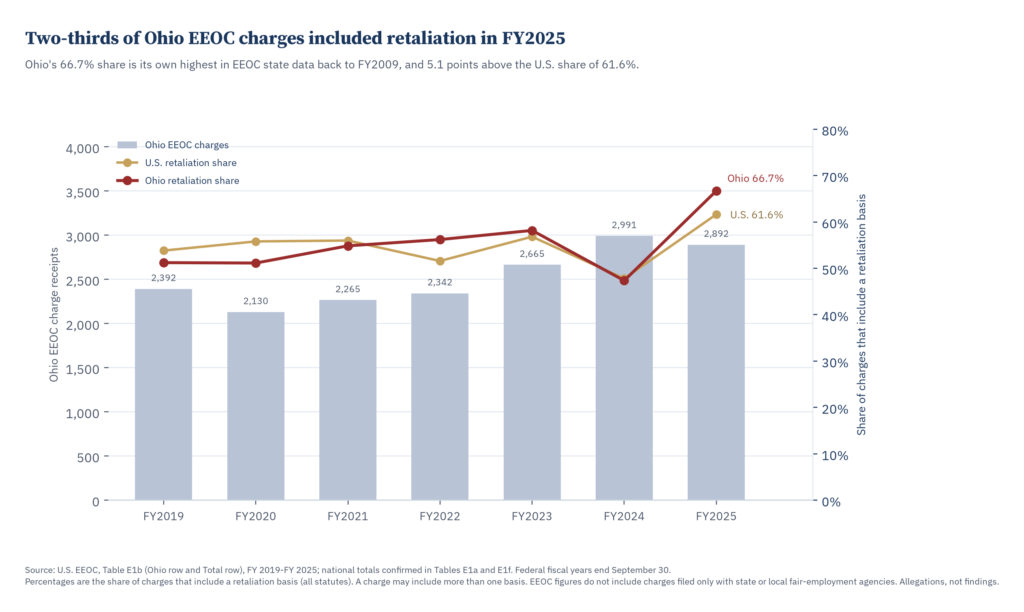
The EEOC’s Ohio counts are receipts of charges filed with the federal agency, by federal fiscal year. They do not include charges filed only with a state or local fair-employment agency. In FY2025, Ohio accounted for 2,892 of 88,201 U.S. receipts, or 3.3 percent, in line with recent years.
What has changed is the mix. Ohio’s share of EEOC charges with a retaliation basis was 58.2 percent in FY2023, fell to 47.3 percent in FY2024, and rose to 66.7 percent in FY2025. The national share followed the same pattern: 56.8 percent, 47.8 percent, and then 61.6 percent. This brief reports that FY2024 dip; it does not assign a cause. After the dip, both series reached their highest retaliation shares in the EEOC tables back to FY2009. Disability allegations in Ohio also rose, to 1,307 charges, or 45.2 percent of Ohio’s FY2025 total.
What these figures do not mean
These are counts of charges, cases, and alleged bases and harms, not findings that a violation occurred. A rise in allegations is not, by itself, evidence that employers or others have become more likely to retaliate, or that any one case has merit. The two agencies use different fiscal years and different math: the commission’s 25.52 percent is a share of basis instances, and the EEOC’s 66.7 percent is a share of charges. They should be cited separately. This brief does not advise anyone whether to file a charge.
Methodology
Sources are the Ohio Civil Rights Commission’s annual reports for state fiscal years 2023, 2024, and 2025, and EEOC Tables E1b, E1a, and E1f, for federal fiscal years 2009 through 2025. All figures were downloaded and checked on November 10, 2026. Derived percentages were recalculated from the published counts and, where the source printed a percentage, matched to it.
Ohio commission fiscal years 2024 and 2025 are printed in those reports as July 1 through June 30. EEOC tables are reported by federal fiscal year. A footnote in Table E1b states that FY2023 charges under the Pregnant Workers Fairness Act reflect only those filed from June 27 through September 30, 2023.
A case or charge may include more than one basis or harm, so those categories can sum to more than 100 percent of cases. EEOC Table E1b carries the same warning, and also states that the data do not include charges filed with state or local fair-employment agencies. Because the Ohio commission has a work-sharing agreement with the EEOC, the two series are presented side by side and are never added together.
FY2023 commission figures are treated with care. The report states a total of 6,395 cases, but its basis chart labels sum to that same total despite a note that a charge can have multiple bases, and its employment and regional figures cannot be reconciled with one another. Those chart readings are not used as a trend baseline. Exact FY2024 basis counts and FY2025 regional counts were not published as tables and are not estimated here.
Sources
- Ohio Civil Rights Commission, State Fiscal Year 2025 Annual Report (July 1, 2024–June 30, 2025), especially pp. 47–50. PDF
- Ohio Civil Rights Commission, State Fiscal Year 2024 Annual Report (July 1, 2023–June 30, 2024), especially pp. 36–38. PDF
- Ohio Civil Rights Commission, State Fiscal Year 2023 Annual Report, p. 15 (case total) and p. 17 (charts, used only with the limitations above). PDF
- U.S. Equal Employment Opportunity Commission, Enforcement and Litigation Statistics.
- EEOC Table E1b, Charge Receipts by State and Basis or Statute (All Statutes), FY 2009–FY 2025. XLSX
- EEOC Table E1a, Charge Receipts by Basis or Statute (All Statutes), FY 1997–FY 2025, used to confirm national totals. XLSX
- EEOC Table E1f, Retaliation-Based Charge Receipts and Resolutions by Type (All Statutes), FY 1992–FY 2025, used to confirm national retaliation receipts. XLSX
The government source files listed above are public, so every figure and chart can be reproduced from them.
About the author
Bradley Jeckering is the owner of and an attorney at Jeckering & Associates, LLC (Central Ohio Legal), with offices in Columbus and Mechanicsburg, Ohio. 614-944-5151. https://centralohiolegal.com/
This page provides general information, not legal advice about your matter. Contacting the firm does not create an attorney-client relationship.